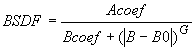
Like the Harvey-Shack scatter model, the ABg model describes scatter from a smooth surface. This model has a logarithmic falloff from specular, with a slope parameter given by G and BSDF given by:
This model is linear-shift invariant, with the BSDF depending only on the difference between the sine of the scatter angle (b) and the sine of the specular angle (b0). Additionally, this model does not support wavelength dependence.
This feature can be accessed by selecting ABg scatter (polished surface scatter) as the Scatter Type in the Create a new scatter model dialog box.
The relative scattered ray power in the specular direction (B-B0 = 0) is Acoef/Bcoef multiplied by the projected solid angle in the specular direction. This product cannot exceed 1 for a 100% scattering surface or the relative ray power contained in the specular ray(s). Failure to satisfy this restriction violates conservation of energy.
Scatter in transmission and reflection All scatter models describe the BSDF as measured over a maximum of 2p steradians. Both transmitted and reflected scatter can be modeled by specifying the two scatter directions simultaneously with the appropriate direction controls found under the Scatter tab in the Surface Dialog.
The following examples show a series of line plots of the log(normalized ABg BSDF) as a function of scatter angle for specular angles of 0, 30, 45, 60, and 89 degrees.
Example 1 The ABg scatter parameters for the following plot are Acoef = .0025, Bcoef = .001, G = 1.8.
Example 2 The ABg scatter parameters for the following plot are Acoef = .0025, Bcoef = .001, G = 0.5, which has the effect of narrowing the distribution function so that the bulk of the scattered light more closely follows the specular path. A small value a G is more appropriate for a smooth specular surface.
Binomial - plane symmetric case of general Polynomial Extended Harvey-Shack - shift variant form of the Harvey-Shack model Extended Scripted - User-defined scattering function that allows manipulation of the scattered rays' polarization state Flat Black Paint – specify Total Integrated Scatter (TIS) Harvey-Shack – for polished surface scatter K-Correlation – analytic PSD Lambertian – for diffuse scatter Phong – cosn from specular Polynomial - General polynomial with diffuse and Lorentzian component Scripted - User-defined scattering function Surface Particle (Mie) – for particulate contamination Tabulated BSDF – measured BSDF data Tabulated PSD – measured PSD data
|
||||||||||||||||||||||||||||||||||||||||||||||||||||||
.gif)
.gif)