The Extended Harvey-Shack scatter model, developed by Alan W. Greynolds, is a variation of the standard Harvey-Shack scatter model that adds a dependence on the angle of incidence by using the functional form:
In the equation above, q = scatter angle with respect to the surface normal coordinate system q0 = specular angle with respect to the surface normal coordinate system b = sin(q) b0 = sin(q0)
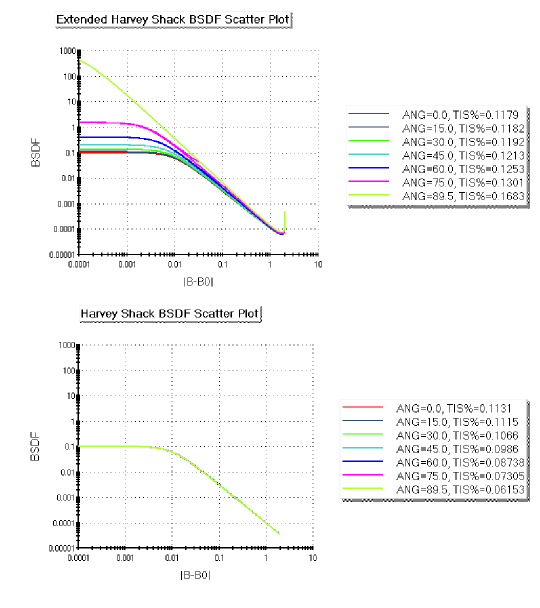
The two |b - b0| plots below show the behavior for an Extended Harvey-Shack model with parameters b0=0.1, L=0.01, S=-1.5, P = 2, Q = 1 and a standard Harvey-Shack with parameters b0=0.1, L=0.01, S=-1.5. Note that all of the curves of the standard shift-invariant Harvey-Shack model fall on top of each other while the variation on the specular angle is exhibited in the Extended Harvey-Shack by a separation of the curves. Furthermore, notice that there is a distinct "tail" in the Extended Harvey-Shack model that is not present in the standard Harvey-Shack representation.
This feature can be accessed by selecting Extended Harvey-Shack (polished surface scatter) as the Scatter Type in the Create a new scatter model dialog box.
ABg – for polished surface scatter Binomial - plane symmetric case of general Polynomial Extended Scripted - User-defined scattering function that allows manipulation of the scattered rays' polarization state Flat Black Paint – specify Total Integrated Scatter (TIS) Harvey-Shack – for polished surface scatter K-Correlation – analytic PSD Lambertian – for diffuse scatter Phong – cosn from specular Polynomial - General polynomial with diffuse and Lorentzian component Scripted - User-defined scattering function Surface Particle (Mie) – for particulate contamination Tabulated BSDF – measured BSDF data Tabulated PSD – measured PSD data
|
||||||||||||||||||||||||||||||||||||||||||||||||||||||||||||||