Navigation: Geometry > Surfaces > Surface Types > Surface Module


Surface Module


Contact Us: fredsupport@photonengr.com


Description


The Surface Module surface type is a construct which can be used to represent the behavior of an ideal lens by specification of a focal distance and image height mapping function.  Keep in mind when using the Surface Module construct that the path lengths are only correct for the infinite conjugate condition.  When path length accuracy is required, the Lens Module surface should be used.  Polarized rays which are incident on a surface module will have their polarization state preserved in the absence of a polarizing coating.


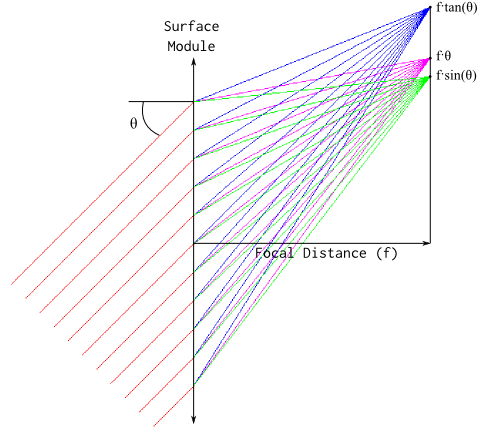
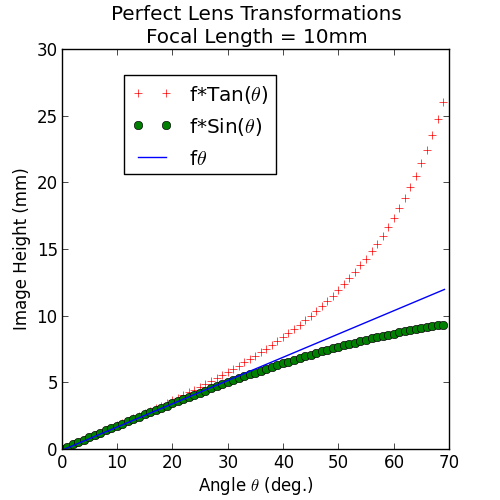
The mapping function is a characteristic quality of the lens you are trying to model, but a "standard" lens will use the f-tan(q) function.  In the first image below, an off-axis collimated ray bundle is input to a surface module at angle q.  At the focal distance of the surface module, the image height of the ray bundle varies according to the mapping function as shown.  The second image below graphs the dependence of image height on input angle for an incident plane wave and a surface module with a focal distance of 10 mm.


Navigation


This feature can be accessed by selecting Surface Module (Perfect focus surface) as the surface Type on the Surface tab of a surface dialog box.


Controls


Control

Inputs / Description

Defaults

Logical Parent

Name of Parent entity.


Name

Name of surface supplied by user.

Surf n

Description

Description of the surface.


Traceable

Surface can be raytraced.

Checked

Use for trimming only

Never raytrace. Surface used for trimming only.

Unchecked

Surface Type

Surface type to create.


Surface Settings

FD

Focal distance of the surface module.  Focal distance is different from focal length in the sense that the latter implies a material.  A collimated source incident on a surface module will come to focus at the focal distance of the surface.

1

Mapping

Specifies the mapping function that determines how ray directions are transformed at the surface module interface.  A "standard lens" will have F Tan(theta) mapping.  Options are:

F Tan(theta)

F Sin(theta)

F theta

F Tan(theta)


OK

Accept settings and close dialog box.


Cancel

Discard settings and close dialog box.


Apply

Accept settings and keep dialog box open.


Help

Access this Help page.


Related Topics


Lens Module

Surface types summary

Create a new surface


Copyright © Photon Engineering, LLC