Defines a Gegenbauer volume scatter model for a material. This two-term phase model has been identified as an effective choice for modelling partially diffuse materials as it offers a compromise between the simpler but potentially flawed one-term Henyey-Greenstein model and the more rigerous but computationally intensive Mie volume scatter model [1]. This feature is not compatible for use with coherent raytracing.
[1] - K. W. Calabro and W. Cassarly, "Modeling scattering in turbid media using the Gegenbauer phase function". Proc. of SPIE Vol. 9333 (2015)
This feature can be accessed in the following ways: •From a materials dialog select the "Volume Scatter" tab, then select "Gegenbauer" as the type.
When the Type is set to Gegenbauer the following additional controls are available:
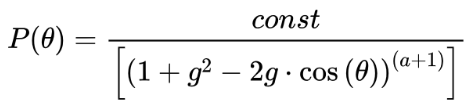
The angular distribution associated with the Gegenbauer volume scatter model is given by the following function:
Where "const" is a normalization constant generated to produce a probability density function. The scattering anisotropy parameter g varies in the range -1 ≤ g ≤ +1; g = -1 corresponding to total backward scattering, g = 0 to isotropic (Rayleigh) scattering and g = +1 to total forward scattering (Mie scattering for large particles). When a = 0.5 this model yields the same results as Henyey-Greenstein.
Concentration can be specified in terms of a scattering coefficient (inverse system units) or as mean-free path (system units).
|